 DailyTechPrices
Google Fitbit Air Explained: The Screenless Tracker vs Whoop
Oct 2, 2026 • Sam for DailyTechPrices • Smartwatches
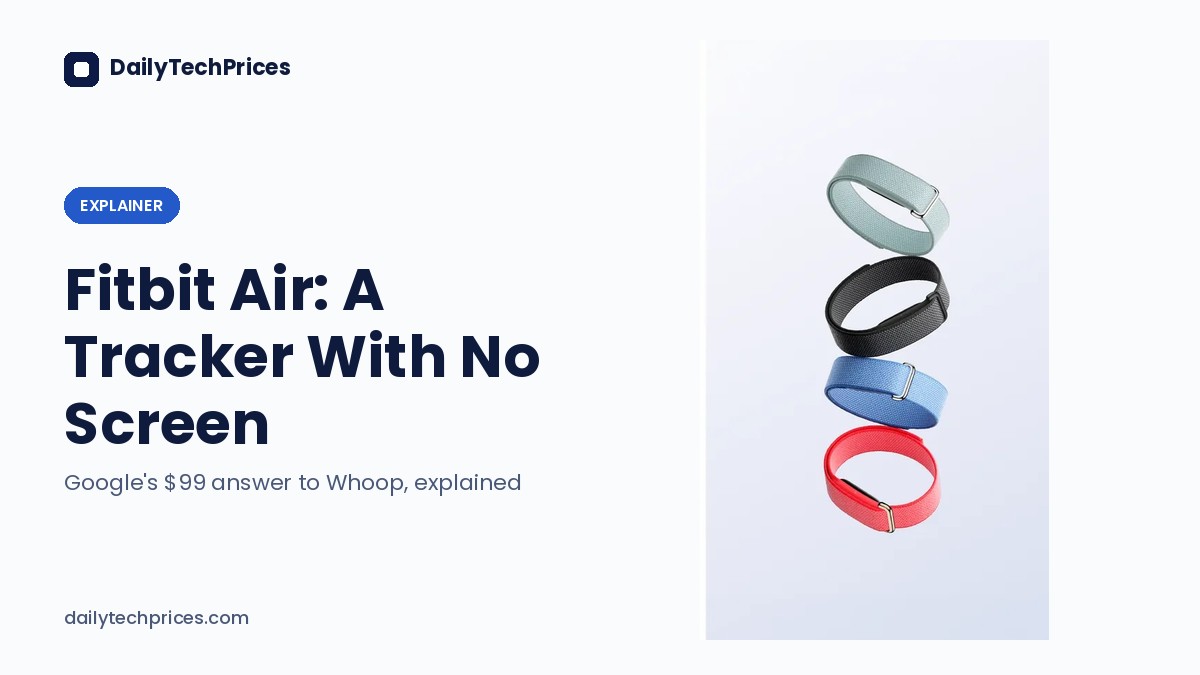
Would you wear a fitness tracker that has no screen at all? That’s exactly what Google is betting on with the Fitbit Air, a tiny band that tracks your heart, sleep and workouts but never shows you the time.
I’ve been a fan of Fitbit’s simple, no-nonsense trackers for a while now, and it’s interesting to see Google go after Whoop’s screenless idea without Whoop’s heavy membership fees. In today’s post, we’ll be looking at the Google Fitbit Air to see what it actually does and whether it makes sense for you. Here’s what we’ll cover: what the Fitbit Air is, design and comfort, health tracking, battery life, the AI coach subscription, how it compares with Whoop and the Xiaomi Smart Band 10, and price and availability in Nigeria.
Quick note: I haven’t used the Fitbit Air myself. Everything here comes from Google’s own announcements and reputable outlets.
What Is the Fitbit Air?
First off, the Fitbit Air is a screenless fitness band. Google first unveiled it in May 2026 in the US at $99.99, and it’s now heading to India at ₹13,999, with sales starting October 2 on the Google Store, Flipkart, Croma, Reliance Digital and other retailers.
The idea is simple. Instead of a watch face buzzing at you all day, you get a small sensor “pebble” on a band that quietly collects data in the background. You check everything later in the Google Health app on your phone. No notifications on your wrist, no screen to crack, and nothing to distract you in the middle of a meeting.

Design and Comfort
Google calls it its smallest tracker yet. The pebble itself weighs about 5.2g, and around 12g with the band, which is very light. For context, the Xiaomi Smart Band 10’s body alone weighs about 16g without a strap.
You get four colors: Obsidian, Berry, Lavender and Fog. The Performance Loop band comes in the box, and it’s made from recycled materials. You can also buy the Active Band (silicone, better for sweaty workouts) and the Elevated Modern Band separately, with bands starting at $34.99 in the US. There’s also a Stephen Curry Special Edition at $129.99 in the US.
According to reports, it survives water down to 50 meters, so showers and swimming shouldn’t be a problem. Google’s own announcement doesn’t spell out the exact rating, so I’d treat that one with some caution.
Health Tracking
This is where the Fitbit Air earns its keep. You get:
- 24/7 heart rate and resting heart rate
- HRV (heart rate variability, the small changes in time between heartbeats, often used as a sign of recovery and stress)
- Irregular heart rhythm notifications for AFib (atrial fibrillation, a type of irregular heartbeat)
- SpO2 (blood oxygen) tracking
- Sleep stages and sleep duration
- Automatic workout detection
There’s also a neat feature where you can log gym workouts by taking a photo of the equipment, and the AI works out what you did.
Of course, none of this is a medical device, and it’s not a replacement for a doctor. It’s a wellness tracker that helps you spot patterns.
Battery Life
Google says the Fitbit Air lasts up to one week on a charge. A 5-minute fast charge gives you a full day of use.
That’s good, but it’s not the best in the class. Whoop quotes around 14 days, and the Xiaomi Smart Band 10 is rated for up to 21 days. That aside, 7 days is plenty for most people, especially since the quick charge means you can top up while you bathe in the morning. And with NEPA taking light when it likes, a tracker that needs only 5 minutes of charging is a real plus.
The AI Coach Costs Extra
Now, here’s the part you need to know before buying. The Fitbit Air itself doesn’t require a subscription. Your basic tracking, heart rate, HRV, sleep stages, SpO2 and AFib alerts, keeps working after you pay once.
However, the smarter stuff sits behind Google Health Premium. That’s where you get the Google Health Coach, the AI coach that gives personalized insights and recommendations, with optional Gemini integration. In the US it costs $9.99 per month after the free trial, which is around ₦14,000 per month. Every Fitbit Air comes with a three-month trial.
In a nutshell, the band is a one-time purchase, but the “brain” is a monthly bill if you want it.

Fitbit Air vs Whoop
The Fitbit Air is clearly aimed at Whoop, the screenless band loved by athletes and fitness influencers.
The big difference is the business model. With Whoop, you pay for a membership, and the hardware comes with it. According to Memeburn, the tiers are Whoop One at $199 per year, Whoop Peak at $239 per year and Whoop Life at $359 per year, with Whoop Life including the Whoop MG band with FDA-cleared ECG. That’s around ₦276,000, ₦331,000 and ₦497,000 per year. If you cancel, the Whoop band stops being useful.
With the Fitbit Air, you pay $99.99 once, around ₦138,000, and the core tracking keeps working. Even if you add Google Health Premium for a full year at $9.99 per month, you’d spend about $120 on the subscription, still less than Whoop’s cheapest tier on top of the band.
On the other hand, Whoop has the longer battery life at around 14 days, and it has a PowerPack that lets you charge while wearing it, so you never lose data.
Fitbit Air vs Xiaomi Smart Band 10
If you’re in Nigeria and just want a solid tracker, the Xiaomi Smart Band 10 is the obvious comparison. It’s a different kind of product, since it has a 1.72-inch AMOLED screen that shows notifications, the time and your stats right on your wrist. It also tracks heart rate, SpO2 and sleep, and it’s rated for up to 21 days of battery.
The big advantage is that you can actually buy it here. It’s listed on Jumia for ₦93,000 from a third-party seller (Raytech Ventures) as of writing. If you want a screen and easy local availability, the Xiaomi makes more sense. If you want something lighter, with no distractions, plus AFib alerts, the Fitbit Air is more interesting.
Pros and cons
Pros
- Very light, around 12g with the band
- No screen, so no distractions on your wrist
- Core tracking, including HRV, SpO2 and AFib alerts, works without a subscription
- 5-minute charge gives you a full day
- Much cheaper to own than Whoop over a year
Cons
- No screen means you can’t check the time or stats on your wrist
- The AI coach costs $9.99 per month after the trial
- 7-day battery is shorter than Whoop and the Xiaomi Smart Band 10
- Not officially sold in Nigeria
Price in Nigeria
The Fitbit Air costs $99.99 in the US, which is around ₦138,000. In India it’s ₹13,999, which works out to roughly $159 at an approximate rate of ₹88 to the dollar, or around ₦220,000.
As far as I can tell, Nigeria isn’t one of the countries where Google sells the Fitbit Air officially. Reports say it launched in 21 countries across North America, Europe and parts of Asia-Pacific, and India is the latest addition. That means you’d have to import it or buy from a local dealer who brings it in. Expect to pay more than the US price once shipping and the dealer’s margin kick in, and keep in mind the warranty may not be honored here.

Finally, should you get the Fitbit Air? Here’s my verdict.
If you’re a gym person or runner who wants serious sleep and recovery data without a screen nagging you, and you have a way to buy it from abroad, the Fitbit Air is a smart, cheaper alternative to Whoop. I like that the core features don’t disappear if you skip the subscription.
To be honest, though, for most people in Nigeria right now, I’d go with the Xiaomi Smart Band 10. It’s cheaper, it’s on Jumia, and it has a screen. The Fitbit Air only makes sense if you specifically want the screenless experience.